Become a certified Be The Messenger facilitator
Facilitators deliver the Education Edition of Be The Messenger, a full-day training for the adults in a school, titled Being the Messenger: Understanding Diversity and Culture in the Classroom. Dr. Brian Chad Starks created the Framework behind it, and he selects and certifies every facilitator, in collaboration with the Center for Teacher Effectiveness.
This course shows you what you'd teach, what the work asks of you, how your path works, and what certification involves. It ends with a short application for your interview with Dr. Starks.
The Framework you'd teach
Every Be The Messenger training is built on the same Framework: four constructs, and the Messenger Method that runs underneath them. Read this part closely. It's what you'd be standing in front of a staff and teaching.
The Framework doesn't change from one field to the next. What changes is how it's applied to the challenges, culture, and responsibilities of the people in the room, and the Education Edition applies it to the adults in a school. Everyone in that room defines these four words a little differently, so the day starts by asking how you define them, where your definition came from, and what happens when it meets someone else's.
01Identity
Who you areThe lens through which a person sees themselves as a unique individual, and the lens through which society sees individuals and groups, which may be grounded in labels, stereotypes, and biases.
In a school: the impact a student's identity has on their educational experience, and how the lens society sees a student through shapes that student's journey.
02Culture
Where you come fromThe beliefs, values, norms, customs, language, and heritage of a particular group that are essential to their identity and that they use to navigate the world without apologizing. Often passed down from generation to generation.
In a school: how the culture of a group is essential to its identity, and how students use it to navigate life.
03Diversity
What connects usA set of beliefs that values differences in perspectives, identities, backgrounds, religion, lifestyles, cultures, and languages. It includes, yet is more than, race, gender, and class. Differences are our strengths.
In a school: teaching students that differences are our strengths.
04Respect
How you show upTreating yourself and everyone in high regard by appreciating and valuing difference when it comes to identity, culture, and diversity.
In a school: teaching students to treat themselves and others in high regard, where identity, culture, and diversity overlap into respect for valuing life.
The Messenger Method
Underneath the four constructs runs one process, the same one Dr. Starks lived himself. Every training and every facilitator moves people through it in order.
- Self-Reflection
- Facing your story: confronting the wounds that shaped you and understanding your own narrative.
- Self-Awareness
- Understanding influence: seeing how your experiences shape the way you lead, teach, relate, and decide.
- Self-Consciousness
- Raising perspective: understanding how your choices shape the people, communities, and systems around you.
"Through self-reflection, I faced my wounds. Through self-awareness, I understood how those wounds shaped me. Through self-consciousness, I gained the power to live differently."Dr. Brian Chad Starks, From Survival to The Messenger
His shorthand for what the day asks of every adult in the room: "Get uncomfortable to get comfortable." You can hear him go deeper on the constructs in the Soul Session episodes of the Be The Messenger podcast.
Check your understanding
Four situations from a school. Pick the answer that matches the Framework, then check. If you miss one, you'll see why, and you can try again.
From the rooms
Before you decide to carry this work, hear from people who have been in the room with Dr. Starks, in their own words.
"He brings tremendous experience and a research-based approach that provides educators with real data and resources to improve instruction. His 'Being the Messenger' course including a presentation and curriculum that helped teachers learn new content, complete a self-reflection, and develop practical and effective strategies that they can immediately implement in the classroom. Dr. Starks' approach and instructional style allows the participants to talk about very difficult subject-matter and problems in a way that is inclusive and productive. Our organization coordinates a large number of teacher professional development workshops and in my 12 years here, his workshops were among the mostly highly appreciated and evaluated by the participants."Chris Carter, Deputy Director, Virginia Space Grant Consortium
"Dr. Starks is a highly valuable resource to our district as we work to greatly improve outcomes for African American students in our district with regard to academics and discipline. Dr. Starks is straightforward and passionate in his approach in working with us. He has been helping us to use data to identify core causes of some of our needs and establish ways to implement change."Jay McClain, EdD, Assistant Superintendent for Student Learning and Success, Lynchburg City Schools
"Chad provides motivation and direction, and has professionals talking about social inequality in a constructive way, where the same people were reluctant earlier to even touch these issues. He is equally effective in small group interactions and in addressing a meeting or convention."Dr. William H. Matthaeus, Director, NASA Delaware Space Grant Consortium
"I first saw Chad when he delivered one of the most compelling presentations about broadening the participation of minoritized students in STEM that I had ever heard. The way he masterfully threaded criminal sociology with the culture of undergraduate STEM education fundamentally changed how I view my work."Kelly Mack, PhD, Vice President for Undergraduate STEM Education and Executive Director, Project Kaleidoscope, American Association of Colleges & Universities
"Dr. Starks analogized social justice work to participating in a high-caliber sports game: without continued and proper training, how can you expect to do well? How many cultures have you played with?"John Briseno, PhD Candidate, Department of Molecular and Cell Biology, University of Connecticut
Where Dr. Starks' work has led
What institutions and journals have reported about Dr. Starks' work in colleges, school districts, and STEM programs. Principals and superintendents will ask about his track record, so you'll want to know these.
Where the training has been
Dr. Starks has delivered Being the Messenger for K-12 educators in the Portland Teachers Program at Portland Community College, teachers in the Virginia Space Grant Consortium's IN-STEP program, and teachers with NASA Space Grant at Old Dominion University. He has also worked with Lynchburg City Schools, Orangeburg County School District, and Red Clay Consolidated School District.
When you share these, be clear about where they come from. None of them measured the Education Edition training day itself. The Wake Tech numbers come from the college's own report, the Lynchburg description comes from Dr. Starks' record of the work and the district's letter, and the Delaware and ALL-ABOARD results come from articles he co-wrote.
Who Dr. Starks looks for
Certification is by invitation. Dr. Starks looks for people who already believe what the training teaches. Not people who can recite it, but people who have lived it. Read through and see how many of these are yours.
- Identity is sacred.Who you are walks into the room before what you teach does. The way you see yourself, and the way you've been seen, shapes every interaction you have with a student.
- Courage is necessary.You have to get uncomfortable to get comfortable. The training asks adults to look at themselves honestly, and you will do that work yourself before you lead it for anyone else.
- Difference is a strength, not a problem to manage.Different ways of thinking, doing, and being make a staff better. Facilitators help people see that instead of fearing it.
- Every student comes from somewhere, and it matters.You can't reach a child you haven't tried to understand. Knowing the student's environment is where the work starts.
- Respect is taught, not demanded.Schools punish disrespect every day and rarely teach respect. Facilitators change that order.
- Healing is a form of leadership.The adults in a building do their own work before they ask it of students. That is the order the Framework runs in.
- Justice is possible when people heal first.Systems change when the people inside them do.
- You talk about issues, not people.Facilitators stay out of the back-and-forth. They bring the scholarship and the conversation to the level where change happens.
- Excellence is decided before you walk in.Knowledgeable, prepared for the room, confident in the message, and still learning from every audience. No excuses, no script, your own style.
Messengers and facilitators
In Dr. Starks' words: training develops Messengers, and certification prepares facilitators. Anyone who completes the training and commits to applying it is a Messenger. Facilitators are certified to deliver the training to others, which takes more preparation and carries more responsibility.
"We start with who people are before we tell them what to do."Dr. Brian Chad Starks
A quick self-check. No one grades this. Tick what's true for you.
Check your understanding
What an in-house facilitator doesYour role in your own district
An in-house facilitator is the district's own Be The Messenger facilitator. You learn the full training, then deliver it to the people you already work with, on your district's calendar instead of an outside presenter's.
What you'd do
- Deliver the full-day Education Edition to staff and buildings that haven't had it yet.
- Keep the work going after a first visit, without booking an outside trainer each time.
- Fit trainings into your district's professional development days.
Who districts pick
Pick the person your staff already trusts. The title matters less than whether colleagues come to you when a conversation gets hard.
The day you'd deliver
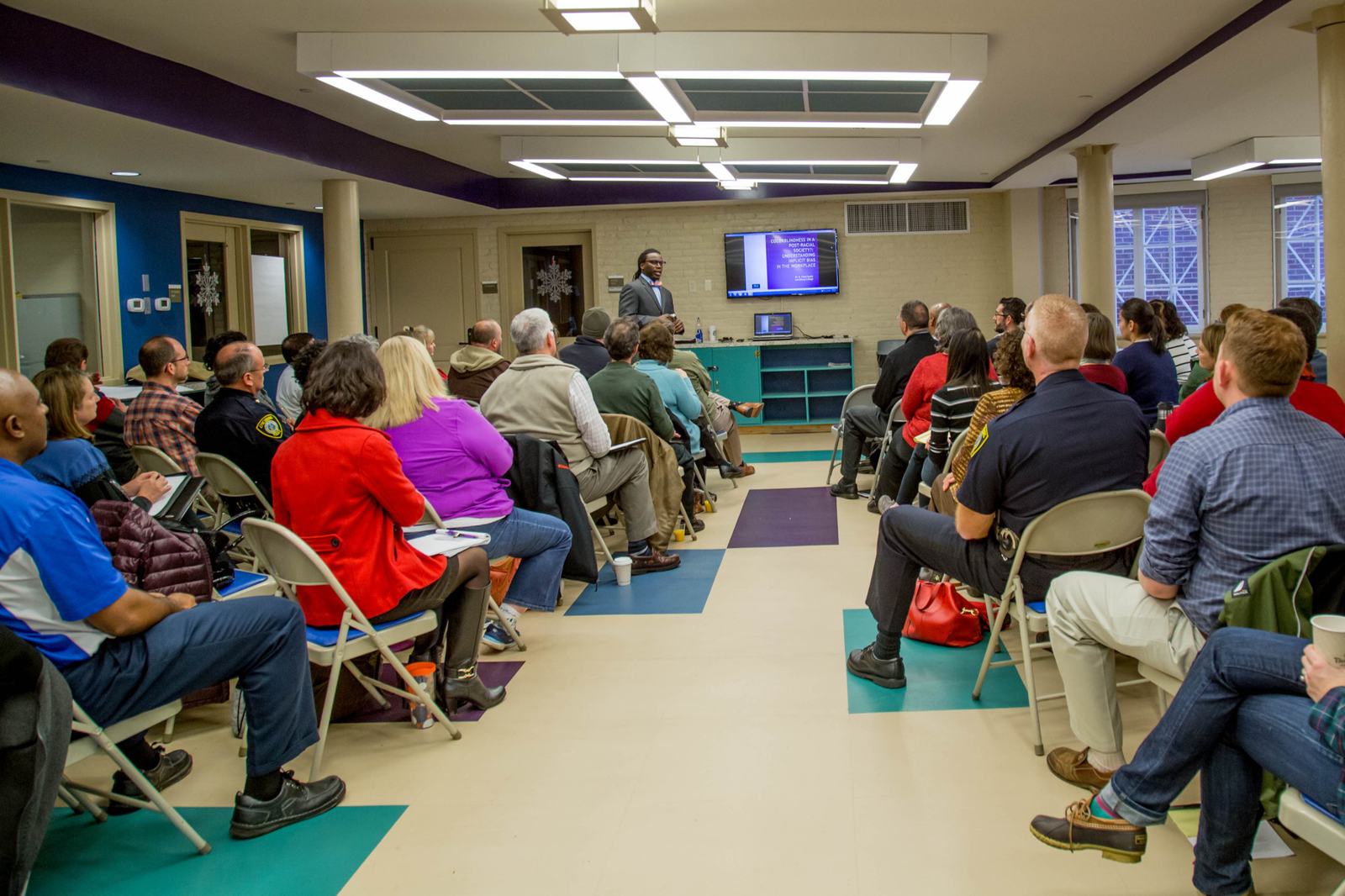
It's the same day Dr. Starks delivers: the student's environment, the school environment, the four constructs, self-reflection, bias and privilege, the collateral consequences of structural inequality, and becoming a Messenger. Participants leave with strategies they can use the next morning.
Dr. Starks describes the moment that tells him the work is working. Halfway through a training, people stand up and read what they wrote about themselves, and colleagues who have worked side by side for twenty years find out how much they share.
What your district gets
A certified facilitator in its own buildings, with the Education Edition manual and the training materials from certification, so the work keeps going after the first day. A district can also start with Dr. Starks delivering the first day and keep it going with its own facilitator.
Bringing it to your district
Your principal or superintendent will ask three things: who has done this, what it changes, and how to pay for it. Here's what to bring.
Who has done this
Lynchburg City Schools is the example a superintendent will recognize: a district looking hard at its own discipline and gifted program data, with Dr. Starks helping it find the causes.
"Dr. Starks is a highly valuable resource to our district as we work to greatly improve outcomes for African American students in our district with regard to academics and discipline."Jay McClain, EdD, Assistant Superintendent for Student Learning and Success, Lynchburg City Schools
What it changes
When adults read a student's environment as an unwillingness to learn, the student ends up with referrals, suspensions, or expulsions, and that interferes with the trust and rapport a child needs before any learning happens. The training gives the adults in a building the skills to expand their ethic of care and increase student success, with particular attention to the students most in danger of falling through the cracks.
How it gets paid for
Districts often pay for professional development from general funds, federal Title I or Title II money, or state grants. Title II, Part A covers professional development for teachers and school leaders, so it's worth asking about first. Your district can also sponsor your seat in a certification cohort.
A note you can send
Edit this however you like, then copy it into an email to your principal or superintendent.
Check your understanding
Think about it
Be honest with yourself here. Nobody sees this answer but you.
If your main goal is extra income, this probably isn't the right fit, and it's better to know that now than after three days. The training asks people to look hard at themselves, and a facilitator has to have done that first.
If your main goal is to carry this work into rooms Dr. Starks can't reach, and you'd like to be paid for it, keep going.
What a facilitator does
A facilitator spends a full day with the adults in a school or district and leads them through the Education Edition. The school or district pays for the day, and you lead the room. The Center for Teacher Effectiveness handles the contract, the billing, and the booking.
The training day
It's the same day Dr. Starks delivers: the student's environment, the school environment, the four constructs, self-reflection, bias and privilege, the collateral consequences of structural inequality, and becoming a Messenger. Participants leave with strategies they can use the next morning.
Dr. Starks describes the moment that tells him the work is working. Halfway through a training, people stand up and read what they wrote about themselves, and colleagues who have worked side by side for twenty years find out how much they share.
It's the same day you read about for your own district, delivered for a room of people you may be meeting for the first time.
How a training comes about
Schools and districts ask for the training through Be The Messenger, and facilitators train where they're invited and booked. Many start in their own district. Certification doesn't come with a set amount of contracted work.
On your terms
No quota, and no requirement to leave your current job. Most facilitators keep their current role and train on days they choose.
How the work and the pay work
Who pays whom
The school or district contracts with the Center for Teacher Effectiveness for the training day. CTE handles the contract, the billing, and the booking, and you're paid for the day you deliver. You never chase a purchase order.
What a day pays
Facilitators are paid for every training day they deliver.
The hard parts
- You won't know ahead of time how many days you'll deliver in a year. Certification doesn't come with a set amount of contracted work.
- The first invitation can take a while.
- The work asks a lot of the person leading it. You'll hold rooms through hard conversations about identity, culture, and bias.
You're not on your own
Contracts, invoices, and scheduling are handled for you, and you have the trainer portal and the training materials from certification.
Check your understanding
Getting certified: how it works
Certification is three days, live with Dr. Starks and the Center for Teacher Effectiveness: two days of Content Mastery and one day of High-Impact Facilitation. Each cohort is announced as virtual or in person. Tuition, and how districts can cover it, is covered in your interview.Tuition, and the ways people pay for it, is covered in your interview.Tuition, and the ways people pay for it, is covered in your interview.
- 1Finish this course. You're almost there.
- 2Apply on the last page, then set up your interview with Dr. Starks. It's a conversation about who you are, where you'd deliver the training, and whether this is the work for you.
- 3If it's a fit, you receive an invitation with a welcome page where you sign the certification agreement and reserve your seat in the next cohort.
- 3If it's a fit, you receive an invitation with a welcome page where you sign the certification agreement and reserve your seat in the next cohort. Your district can sponsor the seat.
- 4Day 1 is Content Mastery. You go through the full Be The Messenger training as a participant first: the student's environment, the school environment, the four constructs, self-reflection, bias and privilege, structural inequality, and becoming a Messenger.
- 5Day 2 is Content Mastery too: the same training, module by module, from the facilitator's side. Why each activity sits where it does, the stories that carry it, and the research behind each practice in the Education Edition manual.
- 6Day 3 is High-Impact Facilitation: setting norms, handling pushback, staying neutral and non-punitive, and taking care of the people in front of you. How to get a room comfortable being uncomfortable.
- 7You leave with certification as a Be The Messenger Facilitator, the Be The Messenger: Education Edition manual, and access to the trainer portal and training materials. Graduate-level credit is available through UMass Global.
You'll deliver the training in your own words, never from a script, with the same content, the same reflections, and the same standards Dr. Starks holds himself to.
Check your understanding
Questions people ask
Open each one.
Do I have to leave my job?
No. You keep your current role and deliver the training to your own staff, on your district's professional development days.
Do I have to leave my job?
No. Most facilitators keep their current role and train on days they choose.
Is there a quota?
No. You train as much or as little as you're invited to and want to.
Who delivers the certification?
Dr. Starks himself, with the Center for Teacher Effectiveness.
Is it virtual or in person?
Each cohort is one or the other, and we say which when we announce it.
What can I deliver once certified?
The full-day Education Edition training, for the staff in your own school or district.
What can I deliver once certified?
The full-day Education Edition training, in your own district and anywhere the training is requested.
Could I deliver it outside my district later?
Yes. Certified facilitators can deliver it in their own district and anywhere it's requested. If your plans change, say so in your interview.
Can more than one person from our district certify?
Yes. A district may want more than one facilitator, so the training doesn't depend on one person. Mention it in your application.
I don't work in a school. Can I apply?
Yes. Pick the role closest to yours in the application, and tell us about your field in the last question. Certification starts with the Education Edition, and applications of the Framework for other fields are in development.
Is a facilitator the same as a Messenger?
No. Anyone who completes the training and commits to applying it is a Messenger. Facilitators are certified to deliver the training to others, which takes more preparation and carries more responsibility.
Does it carry college credit?
Yes. Graduate-level credit is available through UMass Global.
How do people pay for it?
Some pay themselves, some are sponsored by their district, and a sponsorship program is available.
Who handles contracts and billing?
The Center for Teacher Effectiveness handles contracts, billing, and bookings for every facilitator.
Is this a multi-level marketing company?
No. There is no downline, and facilitators earn nothing from recruiting other facilitators. You are paid for the training days you deliver.
What happens after the interview?
If it's a fit, you receive an invitation with a welcome page where you sign the certification agreement and reserve your seat in the next cohort.
Will I talk to Dr. Starks before I decide?
Yes. Your interview is with him, and it goes both ways.
Apply and set up your interview
You've seen the Framework, where Dr. Starks' work has led, what facilitators do, and how certification works. If you want to go further, the next step is your interview with Dr. Starks. Fill this in to apply.
You've seen the Framework, where Dr. Starks' work has led, and how this works inside a district. If you want to go further, the next step is your interview with Dr. Starks. Fill this in to apply.
Thanks. Pick a time for your interview.
We'll email you within two business days to set up a time.
What happens in the interview
- A conversation with Dr. Starks about who you are, where you'd deliver the training, and whether this is the work for you.
- Bring your questions. He'll have a few of his own about your background and the rooms you'd work in.
- If it's a fit, you'll receive an invitation with a welcome page where you sign the certification agreement and reserve your seat.
Have a resume handy? Email it to info@bethemessenger.org.